

A recent article in The Guardian highlights carbon emissions concerns for two proposed data centres.
This article takes a closer look at where the emissions estimates come from.
Plans for new datacentres
The article discusses two planned data centres in England:
Wapseys Wood: 300MW IT load
Quest Park: 720MW IT load, 1GW of generation capacity
IT load covers just the power consumed by servers, without cooling and other energy consumption.
Both data centres would have on-site gas power plants. As The Guardian explains, that’s because of “the long wait to connect to the grid”. The Quest Park request statement says it “has signed an agreement for delivery [of a 200MW grid connection] in October 2034”.
Nationally Significant Infrastructure Projects (NSIP)
NSIPs are large developments that can avoid the usual local planning process. Instead, central government issues a Development Consent Order (DCO).
Both data centres are considered NSIPs, though neither has yet applied for a DCO.
Timelines
The Guardian states that the NSIP regime “allows developers to rapidly deliver infrastructure projects by bypassing local planning authorities with decisions instead handled by central government”.
Quest Park data centre expects a DCO decision by mid-2028. Operations could start around 2030.
CO2 emissions from gas power plants
Foxglove analysis predicts that the two data centres “will produce more than 4.5m tonnes of carbon emissions”.
I’ve not been able to find the original analysis, but the maths basically works on these numbers:
365g of CO2 per kWh from natural gas plants, or 365kg per MWh
8760 hours per year
1.3GW of capacity
Based on that we end up with 4.157 million tonnes of CO2 per year. That’s pretty close to the Foxglove number. I’ve not been able to find any estimates by the data centre providers or the government (which might be because the DCO application hasn’t been submitted yet).
The exact numbers will depend on what conversion factor you use for gas power plants, and whether you assume that the full plant capacity is used.
Contextualizing the numbers
According to Foxglove, the plants “will spew out more planet-heating carbon emissions than the entire UK operations of ExxonMobil”.
Ember Energy reports CO2 emissions by company, showing 3.9 million tonnes of emissions in the UK for ExxonMobil.
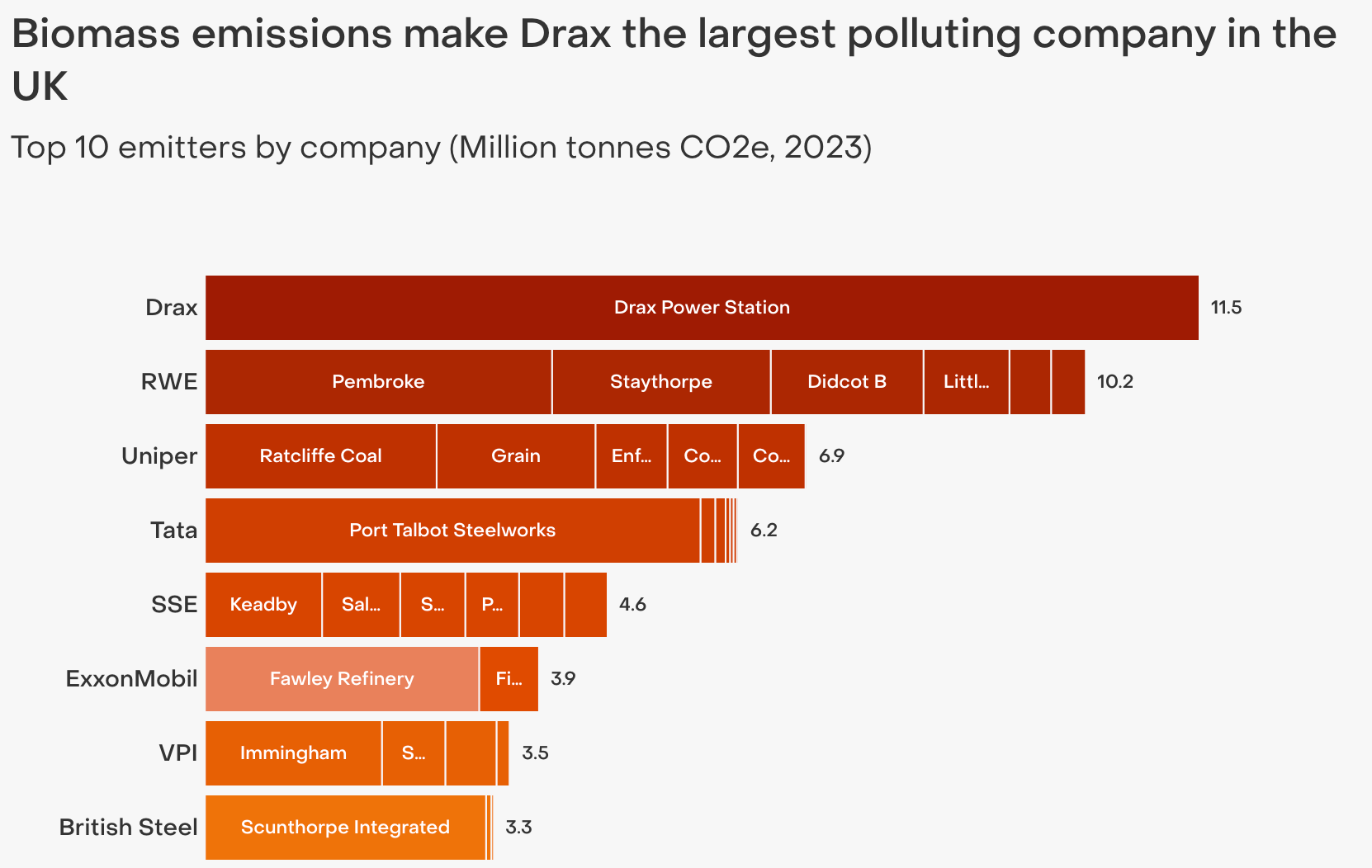
The Office for National Statistics puts total emissions in the UK at 367 million tonnes of CO2e. So the two proposed data centres alone would be 1.2% of that.
Based on consumption, the ONS reports UK emissions at 699 million tonnes of CO2e.
Are the figures misleading?
Someone working for the government says they are:
A government spokesperson said these figures were “misleading” because of the assumption that both projects will run at 100% utilisation from day one, which they said was “not accurate”.
Foxglove provides no justification, calling it “standard industry practice”. This line of thinking is unfortunately common, for example “Carbon Brief assumes a data-centre “load factor” of 90%, which is in line with other analyses”.
In contrast, one study estimates a 62% to 75% load factor for AI training facilities:
electrical infrastructure is routinely sized for worst-case cooling conditions, design-case PUE (power usage effectiveness), and a firm-specific contingency factor, plus headroom for future IT-load expansion
It also notes that electricity draw “varies over the year… because cooling-system response depends on ambient conditions”.
Still, I’m not sure why the government spokesperson focusses on “day one” emissions rather than when sites are fully operational.
Even if more accurate figures were half the reported ones, the overall emissions would still be significant.