

UK building regulations only allow air conditioning to be installed in new residential buildings if developers show that they have exhausted passive cooling methods and can demonstrate that there is a need for additional cooling.
However, these restrictions don’t apply when installing air conditioning in an existing property. What stops owners who want air conditioning from getting it?
Do you need planning permission to install air conditioning?
In May 2025, the UK government expanded permitted development rights in England. In many cases, it is now possible to install reversible air-to-air heat pumps without applying for planning permission, at least when a suitable site is available on the property. These heat pumps can provide air conditioning in addition to heating.
However, you still need planning permission in some cases. For example:
Pure air conditioning units without heating
Individual flats
Listed buildings
In conservation areas (~10% of properties), you also still need planning permission for a street-facing installation.
Common refusal reasons in planning decisions
I used Landcycle to search for rejected planning proposals to install air conditioning units or air-to-air heat pumps.
Out of 31 applications I reviewed, 64% included noise as a refusal reason, and 48% mentioned design or local character. I wasn’t fastidious selecting a representative sample, but this analysis should give a directional idea of the challenges in getting planning permission.
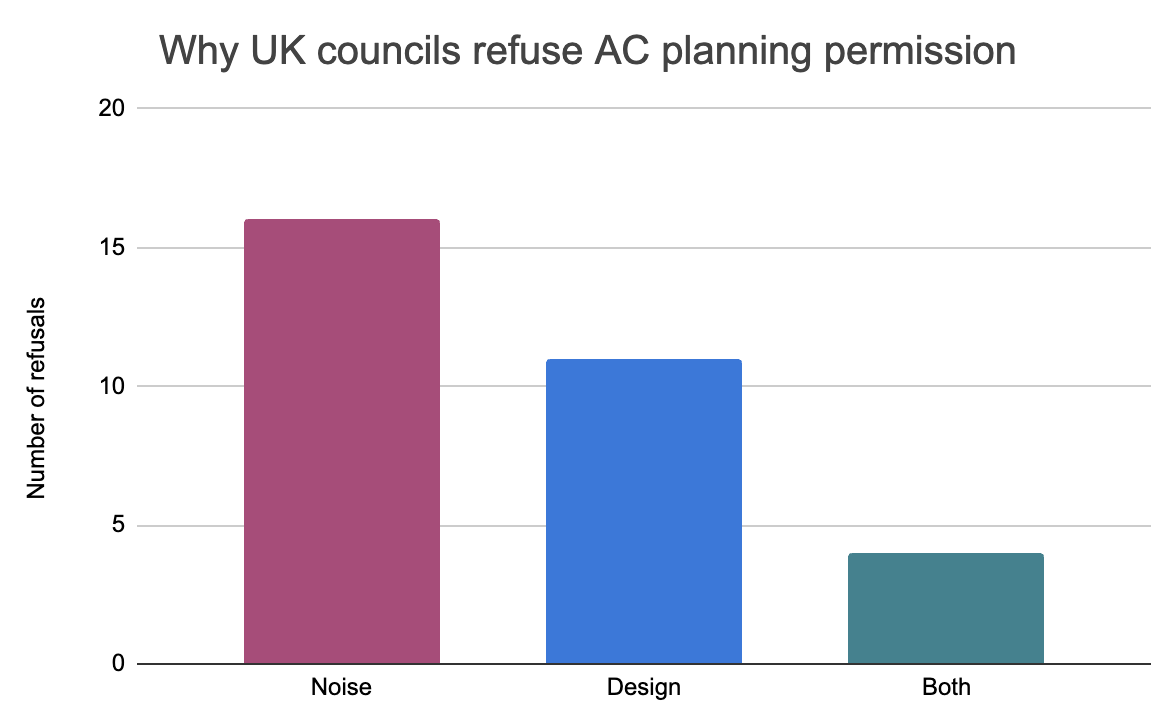
The 2025 changes introduced tighter noise rules for permitted development. At the same time, siting rules were relaxed. I also included pre-2025 applications, so today I would expect slightly more noise refusals and fewer design ones for heat pump installations.
I’m mixing pure air conditioning units, reversible air-to-air heat pumps, and heating-only units in my review. However, assuming planning permission is needed in the first place, I don’t think this makes much difference in practice.
Noise concerns
To get planning permission for air conditioning units, property owners need to show that the noise and vibration won’t negatively impact neighbouring properties.
This is done using a BS4142 noise assessment. It looks at factors like how much noise the device can produce, how the noise travels, and how far away the neighbour’s closest door or window is.
If this assessment fails, planning applications generally get refused:
The proposed air source heat pump would generate unacceptable levels of noise pollution, causing significant harm to the living amenities currently enjoyed by neighbouring residents.
Design & local character
After noise issues, the visual impact of the air conditioning unit is the most common refusal reason, especially if the device can be seen from the street.
For example:
The proposed air source heat pump would be sited in a prominent position and would be readily visible from the street to the front of the property.
As a result, it is considered that the addition of the heat pump at the front of the garage would result in an incongruous addition that would harm the character of the property and wider street scene.
However, outside of conservation areas, ground-level front-facing heat pumps are now allowed under permitted development.
What about sustainability?
Recent reporting covered cases where air conditioning units were refused because climate change adaptation policies required applicants to demonstrate a need for air conditioning.
I’ve never seen this happen outside of Camden, despite spending quite some time looking. So it may not impact more than 0.4% of England’s population.
I’m hoping to write more soon about how Camden’s policies differ from those of other councils!