

While the UK strongly restricts air conditioning in new developments, adding it in existing homes is usually allowed, as long as the installation complies with noise and design requirements. Installing a reversible heat pump often doesn’t even require permission from the local council.
However, the London borough of Camden has taken a particularly strict stance on AC, even for retrofits. Home owners need to show that they really need air conditioning and that alternative cooling methods can’t solve the problem.
In this article I’ll take a closer look at AC planning rules in Camden.
Adapting to climate change: CC1 and CC2 of the 2017 Camden Local Plan
The 2017 Camden Local Plan outlines the council’s development vision and sets out the policies that guide planning decisions in the borough.
Beyond the usual rules on noise and local character, the document contains two policies in the “Sustainability and climate change” chapter that impact air conditioning installations:
CC1 Climate change mitigation: buildings should reduce carbon dioxide emissions
CC2 Adapting to climate change: encourages measures like green spaces and sustainable construction
When does Camden permit air conditioning?
To get planning permission for air conditioning units, Camden residents need to show that:
They’ve explored other steps on the cooling hierarchy (like increasing shade or ventilation)
Dynamic thermal modelling shows that their home is still too hot
CC2 of the Camden Local Plan explains that AC should only be permitted in these specific circumstances:
Active cooling (air conditioning) will only be permitted where dynamic thermal modelling demonstrates there is a clear need for it after all of the preferred measures are incorporated in line with the cooling hierarchy.
This is due to the energy use of air conditioning units as well as their contribution to the urban heat island effect.
In addition to increasing the demand for energy, air conditioning and plant equipment expel heat from a building making the local micro-climate hotter.
Camden blocks AC installation purely for sustainability reasons
Unlike in other councils, in Camden AC retrofits can be refused purely on sustainability grounds.
For example, in this planning application (refused in 2023), there are no noise or design concerns:
The conservation officer was consulted and the air condenser units in this location in terms of design and heritage would not be considered harmful to the character and appearance of the host property or the wider conservation area.
…
Based on the results of the environmental noise survey, the applicant proposes adequate levels to be achieved at 1 metre from the nearest noise sensitive window
However, the applicants failed to take the necessary steps to demonstrate why air conditioning is necessary.
The proposal has failed to justify the need for active cooling by reducing and mitigating the impact of dwelling overheating through the application of the cooling hierarchy, thereby failing to minimise carbon dioxide emissions
In this case, the planning application failed to show that other steps of the cooling hierarchy were followed first, and didn’t submit a thermal model to prove that cooling was still required.
Does this policy really apply to existing homes?
London’s anti-overheating rules usually only apply to new developments. Is this the case in Camden?
When residents appealed the decisions of their local council, planning inspectors have not interpreted this consistently. For example, in this appeal from 2024, the planning inspector states:
However, I agree with the appellant that this requirement appears to refer to proposed buildings and to ensure that such new buildings are designed and modelled to mitigate the effects of possible overheating.
… the cooling hierarchy seeks, for instance, to reduce heat entering the building through orientation, and manage the heat within the building through exposed internal thermal mass and high ceilings.
These are all matters regarding the initial design of the building…
However, in another case from 2022, the planning inspector affirmed that Camden’s rules also apply to existing homes:
This policy is not restricted only to major developments.
The supporting text to the policy sets out that the Council will discourage the use of air conditioning and excessive mechanical plant as, in addition to increasing the demand for energy, such measures expel heat from a building making the local micro-climate hotter.
Newer guidance makes it clear it applies to all development
Overall, my impression is that the restrictions don’t just apply to new builds.
The Local Area Requirements for Planning Applications 2025 are most clear about this requirement:
All new-build development, and any development where air-conditioning is proposed, must demonstrate how the London Plan ‘cooling hierarchy’ has been applied and informed design. Development at risk of overheating (for example, single aspect units within 90 degrees of due south) should submit dynamic thermal modelling demonstrating risk of overheating has been mitigated.
Inconsistency in how the policy is applied
Camden’s unusual requirements have caused confusion for applicants. But planning officers have also not been applying the rules consistently.
For example, here air conditioning was approved without clearly demonstrating need:
Whilst AC units are not typically supported for environmental reasons, in this case the building is an existing dwelling with limited scope to retrofit
However, this precedent is not a reason to overturn the council’s planning refusal on appeal:
The appellant has submitted numerous examples of approvals within the Borough of similar recent development where a cooling hierarchy or thermal modelling were not required.
Such inconsistency in the application of policy is regrettable, however, this does not alter the clear wording and requirements of the policy before me.
Do you really need dynamic thermal modelling?
Notably, in this case a cooling hierarchy statement was submitted with the planning application in the example above. It mentioned several existing overheating mitigations, for example:
Overhanging eaves
Additional wall and roof insulation
An efficient boiler to reduce internal heat generation
Use of high thermal-mass materials
Mechanical ventilation
The applicant stated that these measures “have not been effective in maintaining comfortably cool temperatures”, however this was not deemed sufficient:
A cooling hierarchy has been submitted by the appellant and I am satisfied that, as development serving an existing flat, the preferred measures set out in the policy and Policy SI 4 of the London Plan have been addressed.
However, no thermal modelling has been submitted and therefore the clear need for the units have not been demonstrated. The requirements of the policy have not been met.
Camden’s home improvement planning guidance is confusing
Camden’s home improvements guide from 2021 explains that air conditioning is discouraged and that other options should be “considered”. That’s a much weaker standard than what is sometimes required by planning officers.
If you are concerned that your home overheats in summer beyond comfort levels, you should consider passive cooling measures which do not rely on an energy source like air conditioning.
The guide explains that planning applications require a noise assessment and a statement of what other cooling measures have been taken.
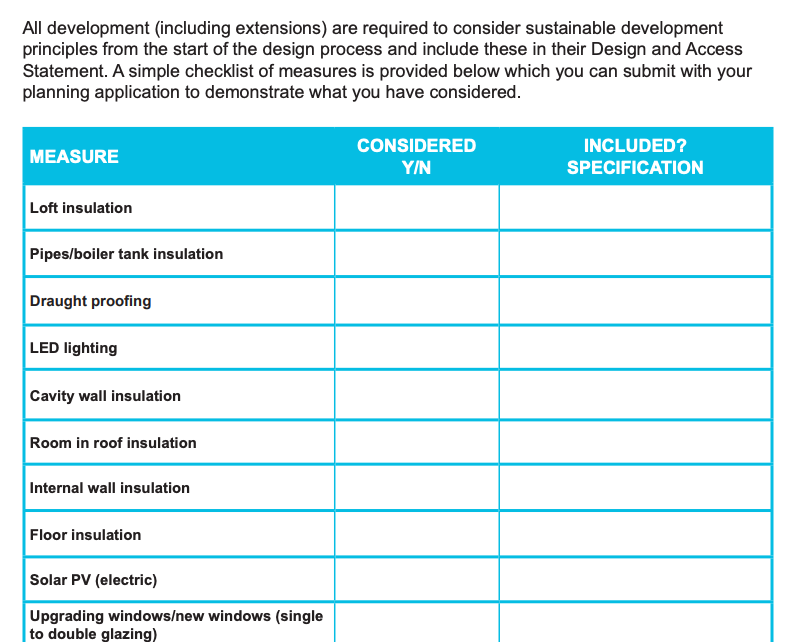
Air conditioning units require planning permission and the submission should include a Noise and Vibration assessment as well the table in Appendix 1 completed stating all the other measures that have been taken to address overheating in your home.
This table is not specific to cooling measures. Dynamic thermal modelling is never mentioned in the guide. I can understand why someone might submit a planning application with just the documents outlined here, without checking additional council guidance.
Extensive effort, but still a technical breach
The Telegraph’s reporting mentions a case where an applicant successfully received planning permission on appeal in early 2026, a year and a half aftre their initial application.
The applicant documented numerous steps that were taken to achieve cooling through passive means, as well as submitting a dynamic thermal model to show that further cooling was required.
The council challenged the lack of ceiling fans and an MVHR+ system to achieve cooling without air conditioning. However, the applicant argued that these measures would not be effective:
Ceiling fans … will only have the effect of moving warm air around the room in any case
…
The installed MVHR system provides external air tempering by its very nature, it will exchange warm internal air and exchange it for cooler external air.
If the incoming air was to be mechanically tempered, this would require an outside air conditioning unit to run through an internal coil within the MVHR unit, this would constitute by very nature an air conditioning system.
Despite this, the planning inspector did not conclude that this clearly met Camden’s requirements:
The appellant’s commentary on the appeal scheme and measures already taken at the appeal property against the cooling hierarchy goes some way to explaining the absence of both ceiling fans and the MVHR+, both of which the Council consider should have been incorporated prior to the AC system.
I find the appellant’s reasoned justification in these respects to be compelling.
However, it seems to me that there remains limited technical justification for the 3 AC units and the need for that level of system to cool the building.
In the absence of such the appeal scheme would amount to a technical breach of the provisions and aims of CLP Policy CC2.
However, the appeal was ultimately granted because the extensive prior work showed a “continued commitment to the principles set out by the cooling hierarchy” and that installing AC “would not be inconsistent with the broad aims and provisions of those policies”:
Furthermore, although not decisive, it is clear that the extensive combination of measures and steps already taken, together with the AC system, suit the appellant’s particular needs and the constraints of a retrofitted property.
…
I am satisfied that material considerations exist sufficient to justify a decision otherwise than in accordance with the development plan.
This highlights that, when planning rules are rigorously applied, Camden residents need to go to extraordinary lengths to get AC approved.
Planning permission granted only with the cooling function of a heat pump disabled
When heating, heat pumps are significantly more efficient than gas boilers and their emissions go down as the electricity grid decarbonises. That’s why they are generally considered to be sustainable technology.
Reversible air-to-air heat pumps can also act as an air conditioner.
I found one case where a building extension was approved, however as one of the conditions the cooling option of the heat pump had to be disabled:
Prior to first use of the air source heat pump hereby approved, the active cooling function shall be disabled on the factory setting and the air source heat pump shall be used for the purposes of heating only.
Reason: To ensure the proposal is energy efficient and sustainable in accordance with policy CC2 of the London Borough of Camden Local Plan 2017…
Opposition to AC from local groups
It’s not just planning officers interpreting Camden’s AC rules strictly. The Hampstead Neighbourhood Forum also objected to air conditioning on sustainability grounds on several occasions.
For example, from a comment on one planning application:
We also question whether the applicant has provided enough justification for the proposed air conditioning unit, which is discouraged by Camden Local Plan Policy CC2, and wonder if the applicant has considered more sustainable heating and cooling methods as recommended by Camden guidance.
Or, from the planning application above where the cooling function was disabled:
The emerging Hampstead Neighbourhood Plan supports the green heating and cooling hierarchy, which emphasises energy conservation, followed by the utilisation of renewable energy sources and efficient technologies, to achieve environmentally friendly and sustainable heating and cooling systems. Active air conditioning would be contrary to this policy.
In a 2021 comment, The Camden Square Conservation Area Advisory Committee also expresses concern about the number of AC units proposed and their environmental impact:
There are two air conditioning units placed at the front and two at the rear of the property which seems an excessive number for the size of the flat.
…
The application form (under “Environmental Impacts” section) indicates that the units are heat pumps.
Whilst A/C units can be considered to be a form of heat pump. In this instance the form is for describing energy efficient air source heat pumps or similar, providing a positive, sustainable solution. However, air-conditioning units are not energy efficient choices.
Does this still matter after the 2025 changes to permitted development rights?
Permitted development rights allow owners to make changes to their property without requiring permission from their local council. Since May 2025, installing a reversible air source heat pump is allowed across England (including Camden), under certain conditions. Prior to the change, permitted development rights only applied to heat pumps that were “used solely for heating purposes”.
The current permitted development rules allow one heat pump per block of flats. However, in practice it’s difficult for an individual owner to get freeholder consent and comply with noise regulations. Flats account for 84% of homes in Camden.
There are also additional restrictions in conservation areas, which cover 70% of Camden’s built-up areas. There are 5,600 listed buildings where planning permission is still required.
This map shows conservation areas in Camden:
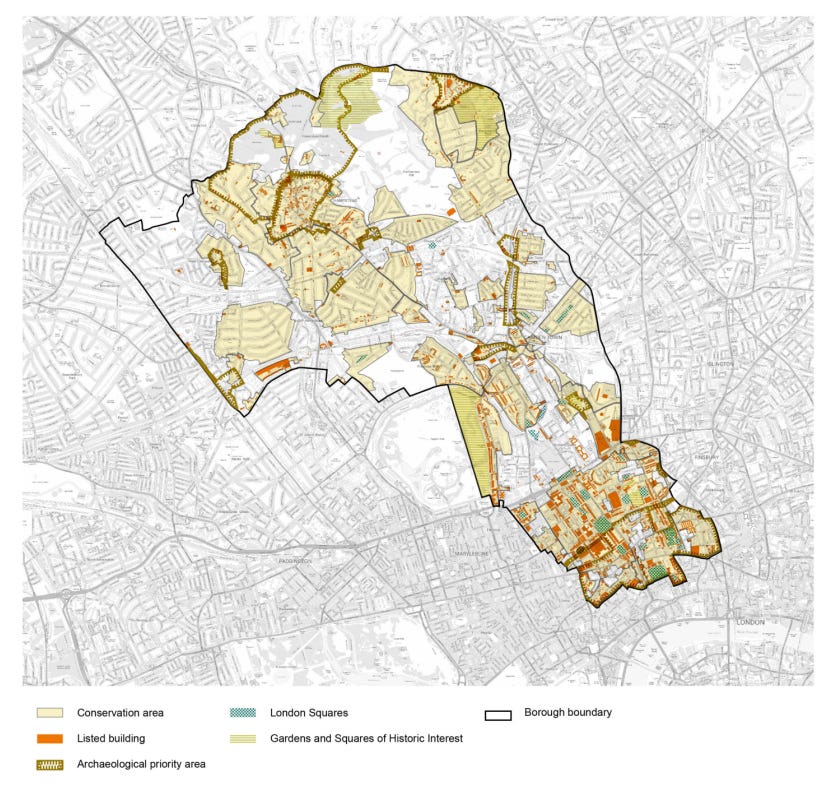
Overall, I think most people in Camden would still need planning permission to get air conditioning.
Permitted development doesn’t apply to cooling-only devices – but I don’t think that matters
Permitted development rights do not apply to pure air conditioning units:
Development is permitted by Class G subject to the following conditions… the air source heat pump is not solely used for the purpose of cooling
However, I get the sense that this doesn’t matter in practice since cooling-only devices are rare:
Modern air conditioning systems are reverse cycle heat pumps, not simple cooling units. Cooling-only systems are now very rare in the comfort cooling market.
Therefore, this requirement does not add any extra cost.
Camden’s new draft local plan
Camden is developing a new local plan and published a draft in 2025. Chapter 8, “Responding to the climate emergency” reaffirms that residents need to demonstrate the need for active cooling.
The chapter discusses overheating and cooling specifically:
…it is important to ensure that buildings and spaces in Camden are designed to promote cooling and reduce overheating, while avoiding the use of mechanical cooling, which often has significant energy requirements and, under conventional operation, expels hot air, which adds to the risk of overheating.
This will reduce the impact of overheating in the borough and reduce inequality in the experience of heat impacts.
The new policy CC8, “Overheating and Cooling”, takes a strong stance against air conditioning in new builds and clarifies that restrictions also apply to existing homes:
Proposals for active cooling in new residential developments are unlikely to be considered acceptable
…
[We will] only permit applications for new and/or additional active cooling systems or units where all other feasible measures in the cooling hierarchy have been integrated into the development and there is still a clear need for active cooling demonstrated by dynamic thermal modelling.
In addition to demonstrating need, applicants should also offset the energy use of AC through additional measures.
Where applications for active cooling are considered acceptable, the energy used to operate the active cooling system should be offset through the installation of solar PV and greening, to help cool the local environment, where feasible
This suggests that, unless permitted development rights apply, it will get even harder for Camden residents to install air conditioning.