

A while ago The Telegraph covered planning rules that forced homeowners to remove air conditioning units from their homes “under climate laws”. Other news outlets also covered the story.
In the article, The Telegraph reports on three different cases where retrospective planning permission was refused for air conditioning units in Camden.
Let’s take a look at what happened in each one, and review some of the additional coverage in The Telegraph and other news outlets.
Case 1: Rejected due to sustainability requirements – appeal rejected
In August 2022 a retrospective planning application for two air conditioning units was submitted. They were installed on the roof at the rear of the building.
An acoustic assessment confirmed that noise levels at neighbouring properties would be acceptable. The conservation officer stated that the AC units would “not be considered harmful” to the local character of the conservation area.
The planning application was rejected only on sustainability reasons:
The proposal has failed to justify the need for active cooling by reducing and mitigating the impact of dwelling overheating through the application of the cooling hierarchy, thereby failing to minimise carbon dioxide emissions
The property owner appealed and the appeal was rejected in January 2024.
An overheating analysis produced in June 2023 found that “the flat passes the relevant tests… on the basis that windows can be opened to allow for cross ventilation“.
Air conditioning might still be allowable if opening windows isn’t practical. The appeal decision considers potential security concerns, but dismissed them.
There would be security concerns associated with leaving windows and balcony doors open when the flat is unoccupied or at night, but there does not appear to have been any examination of how these could be addressed.
Such security concerns would not be as great as those associated with ground floor windows, as mentioned in the [overheating report].
Case 2: Rejected due to sustainability requirements – appeal allowed
Three air conditioning units were installed on the roof in September 2023. In August 2024 a planning application was submitted, followed by an overheating risk assessment in December 2024.
Camden rejected the application in December 2024 because the proposal failed to show that “all feasible passive and other design measures to reduce overheating” were incorporated before air conditioning was considered.
The council stated its case in response to the homeowner’s appeal:
The applicant’s assertion that ceiling fans cannot be factored into the assessment contradicts the provisions of TM59:2017, which explicitly state that ceiling fans must be considered when they are proposed as part of a new build or refurbishment.
The council acknowledged that solar shading might not be viable at the front of the building due to design concerns, however it pointed out that “such measures could feasibly be introduced on the rear extension”.
In February 2026 a planning inspector allowed the appeal:
Whilst I am not persuaded that there is sufficient technical justification for the three AC […], it is clear that the appellant has considered and implemented where practicable the provisions of the cooling hierarchy.
[There] are material considerations that lead me to conclude that the appeal scheme would not be inconsistent with the broad aims and provisions of [Camden’s] policies
Case 3: Rejected due to design, noise, and sustainability – appeal refused
In July 2020 two air conditioning units were installed in the front garden, as well as two in the rear garden. In February 2021 the owner submitted a planning application.
Planning permission was refused in November 2021 based on three reasons:
A “detrimental impact on the character and appearance” of the building
Noise levels impacting the adjoining buildings
Failure to demonstrate the need for air conditioning through dynamic thermal modelling
On appeal, the planning inspector was “satisfied that the two front units do not harm the character and appearance of the property nor the wider CA [conservation area]”.
However, the noise and sustainability objections were upheld in September 2022:
I therefore find that it has not been demonstrated that the development has an acceptable impact upon the living conditions of occupiers of existing properties, […] with regard to noise disturbance.
A cooling hierarchy has been submitted […] However, no thermal modelling has been submitted and therefore the clear need for the units [has] not been demonstrated
What the three cases show
Camden Council has repeatedly refused planning permission for AC units on sustainability grounds. It has not always been successful on appeal, as the most recent case shows.
The cases where Camden was successful ended in 2022 and 2024. In 2025, England-wide permitted development rules were extended to no longer require planning permission for air to air heat pumps for some homes. However, I think the cases covered here are mostly outside the scope of those changes.
I also don’t think Camden has changed their policies over the last few years.
Were perfectly operational AC units removed across London?
After discussing example cases from Camden, The Telegraph reports that AC installers they talked to have reported removing functioning AC units across London:
Air-con engineers told The Telegraph that they had been called out to remove perfectly operational units worth thousands of pounds across London.
In an article discussing a “net zero clampdown” you might think this refers to AC units being removed for sustainability reasons. But if you read carefully, the sentence makes no reference to climate change policies!
AC units are removed frequently, but mostly for noise and design reasons.
Planning rules in Islington
The Telegraph mentions air con policies in Islington:
Other London councils have also attempted to restrict the use of air-con on climate grounds, including Islington, which says it “must only be considered as a last resort”.
This is stated in the Islington Local Plan:
Full-building mechanical ventilation and active cooling systems must only be considered as a last resort.
…
[For minor home extensions] the use of active cooling measures will not be accepted, unless it can be demonstrated that other methods higher up the hierarchy cannot be used to deliver sufficient heat control.
While I’ve not read the Islington Local Plan in full, I think the language is very concerning if you’re an Islington resident and want to install air conditioning in a flat (where permitted development rules mostly don’t apply).
But from what I can tell, Camden’s climate change policies and their enforcement for existing homes is unique.
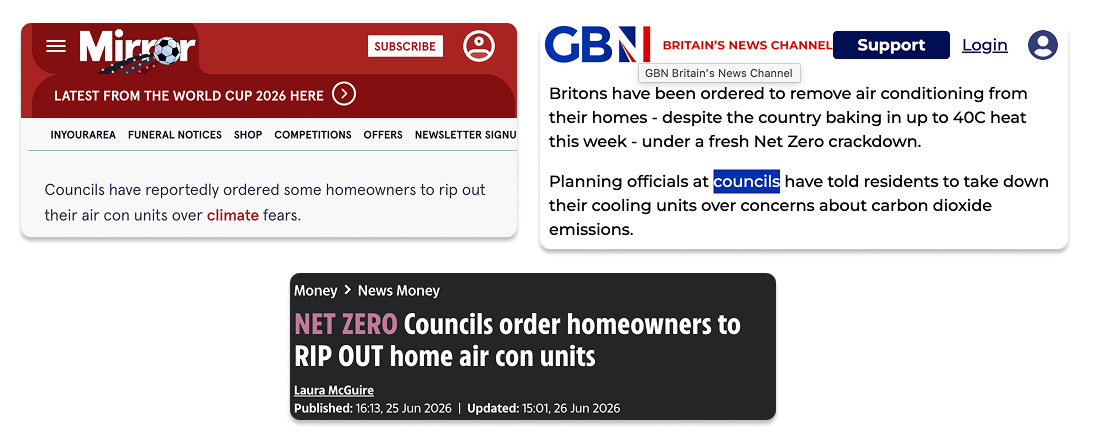
The Sun, The Mirror, and GB News: an unjustified plural
The reporting in The Telegraph prompted articles by other news organisations. For example, GB News states:
Planning officials at councils have told residents to take down their cooling units over concerns about carbon dioxide emissions.
As I explained, this does not follow from a careful reading of the Telegraph article, which presents no evidence that other councils have ordered the removal of AC units for climate change reasons.
Is air con just not permitted because of how it is installed?
Techradar claims the news stories about AC planning refusals are mostly not due to environmental restrictions on air con:
If you look at the detail of the newspaper stories you’ll typically find that the problem wasn’t the air con itself, but how and where it was installed.
No examples of this are cited in the article, but the prior paragraph mentions the reporting by the Telegraph.
As I’ve shown earlier in this article, sustainability was cited as a refusal reason in all three cases. In one case this was ultimately overturned on appeal. In another, it sits as one of two reasons along with noise concerns.